There’s something about getting your hair cut in a foreign country that I just can’t put my finger on. That’s because the slightest thought of getting my hair cut in a foreign country causes my body to start violently convulsing, and it’s really just difficult to point something out when your finger won’t stay still. Of course, what I’m trying to say here is that when it comes time to get my haircut here, I do just about everything I can to delay the inevitable for as long as possible. In the nearly ten months since I’ve been here, I’ve gotten my haircut 5 times. Four times by American’s, and one time by an experienced, and Mozambican familiar with the intricacies of white-people-hair (and apparently there are intricacies).
The first time my friend Kevin, another PCT at the time, did it. And he was good. He did it on the front porch of my host family’s shack. The second time Rafael, another friend and PCV from a nearby site took a turn using a shoddy set of shears that Chris, the volunteer who lived in my house before me had purchased at Montepuez’s infamous “Chinese Loja,” the one stop shop for all things quality (…he said sarcastically). It didn’t actually turn out that bad, though my thick hair kept jamming the shears and the machine itself broke two or three times along the way. One time, it stopped mid-cut and demanding us to open it up and perform some open-heart-of-the-machine surgery. The third time was in Angoche, where Kevin (same Kevin actually), Casey and I all ventured into the bairro’s of the hosting city to seek out someone who could clean us up. That he did, and I think I already mentioned in the post about my trip that he cleaned-up Casey particularly well practically leaving him bald. Anyway, this guy had cut white people hair before, so it wasn’t so new to him. Still terrifying, but not change-your-pants inducing terror. Foreign country haircut experience number four occurred in Mireya and Anna’s Quintal, where I contracted Elizabeth, yet another volunteer from a neighboring site, to do the dirty on my head. In this case, the dirty being bushwhack through my dusty, gross and oiley hair, and then make something out of it. Number five shouldn’t really count, but I’m throwing it in there anyway. My neck was itching me one day while visiting the girls house, so I handed Mireya a pair of scissors and asked her to fix the problem. A few snips later and that was all she wrote. Hair cut number six happened today.
I returned home from a failed meeting, but otherwise successful garlic restock in the city to the realization that I had most of the afternoon free. There are a number of things that I needed to do, but like any sane person having been given the gift of time, I instead decided to waste it doing things that were much less important. So, I went to get my haircut.
My friend Genito, a 10 or 11 year old who sometimes comes to my house to break stuff and other times just to draw, set out in search of a guy. I’d call him a barber, but they don’t really exist in the professional sense here. A barber in this country is anyone who has a set of clippers (most likely the same shitty pair I had in my house, and purchased from the Chinese Loja) and a bamboo hut blasting music from gigantic, cheaply-made speakers (probably also purchased at the Chinese Loja…I told you they have everything).
To find our guy, we walked around the bairro making a few friends along the way as we asked for directions. Eventually, a small army of pre-teen boys and I arrived at a small hut down the street from my friend Lucas’ house. Inside the three foot by four foot hut was a man sitting and reading a newspaper in front of two speakers that were blasting music loud enough that it was causing the corners of the paper he was holding to dance to the beat. I tapped him on the shoulder, and thus began my plunge into the world of back-alley barbers.
Our conversation went kinda like this:
Me: “Hey man, I need to cut my hair, can you do it?”
Him: “Hold on, let me turn down this music…**screws with about seven of the 15 knobs on the speaker until it finally decreased the volume**…What did you say?”
Me: “I need a haircut, do you know how to cut white people hair?
Him: “Meh, no, not really. I’ve never done it before, but no worries, right? Hair is hair.”
Me: “Yeah, sure, whatever, I have no idea. All I know is that the last time a Mozambican cut my hair, he sold what he cut off to some kids who wanted to make fake beards.”
Him: “Yeah, I’m probably gonna do that too. Cutting hair doesn’t really make me all that much money, the real cash crop is in the extension business.”
Me: “Oh, they’re fake? I had no idea. I thought all those smooth, technicolored streaks I’ve been seeing in peoples hair were naturally occurring.”
Him: “Ha! You are just too much whitey.”
Me: “Dude, I’m kidding. Most of that crap is made from horse tails.”
Him: “Negative amigo, we don’t have horses here.”
Me: “China?”
Him: “China. Wait, what are we talking about?”
Me: “Hair…speaking of which, can you cut mine.”
Him: “Yeah, but I’ve never done it for a white person before.”
Me: “Don’t worry, we’re in this together buddy. Do you have a number 3 clip?”
Him: “Yeah, it’s here somewhere. What a three look like? Oh well, don’t worry, I think this is it. Ok, let me go ahead and lube up this rusty set of shears I have. By the way, who are all these kids?”
***10 agonizing minutes or jammed clippers and hair-pulling pain later I’m looking spick and span.***
Me: “Hey wow, that’s not half bad. And I’m not even bleeding!”
Him: “It’s all in the wrist, bro.”
Me: “Yeah, I guess so. I really have no idea; haircuts have never been my thing.”
Him: “Really? Wow, that’s a shame. Haircuts are great. In fact I demand you come back soon.”
Me: “Well, hair needs to be cut, that’s why it’s there, right?
Him: “Actually, I believe that real reason we’ve evolved to have hair on our heads is threefold: for warmth, the reelecting of harmful UV rays, and for protection against impact.”
Me: “Ugh…come again?”
Him: “Darwin mothafukah, what up?!”
Me: “Well, thanks for that, ugh, lesson? And here’s your money. I’m assuming you’re gonna overcharge me anyway, so here’s 20 mets.”
Him: “Well that makes this a whole lot less awkward. Thanks for understanding! Sorry that you’re different and have a great day!”
Haircuts. Now you see what I mean?

Tuesday, August 13, 2013

Friday, August 9, 2013
My first Ide
And all of a sudden, it feels like my foreign allure as a Peace Corps Volunteer has earned me admission into the outskirts of a pretty sweet social circle. I spent the afternoon brushing shoulders with some of the city’s higher-ups while we inhaled plate after plate of savory, fall-off-the-gigantic-bone meat dishes, fries, rice, salad, and all the shamosas you could ever want.
We were celebrating Ide, an important day that marks the end of Ramadan and the month-long fast endured by Muslims. Faruk, a well-off and festive Mozambican I met after his boss gave Vikram, Anna and I a boleia to Macomia once, invited me, Anna, and Mireya over to his house to celebrate with some of the town’s elite. A couple university Professors, the Municipal Judge, the Commander of the local Army Base, a few prominent Store Owners and Delacaya, a chiquey Mozambican who works at the Mcel Telephone Store and has a passion for club dancing, we all in attendance. Of course, I had no idea who any of these people were (with the exception of the cell phone guy, who I’d met a few times before). But when the Scotch started following, that all changed.
We sat down to eat in the early afternoon and stayed seated as we went through the first course, indulging in just a few of the aforementioned delicacies. And then we drank some Scotch.
The second round of food was served buffet style and was heavy on the meat. Following Mireya’s bold lead, I dove right in, building a mountain of food on my plate until I got to a point where the slope of the pile was so steep that if I’d added anything else, it wouldn’t have fallen off. A pleasant change of pace from my own under-flavored cooking, it took me a little under 3 minutes and 30 seconds to show that stack of food who it’s daddy was. And then we drank some more Scotch.
As it turned out, there was more reason to celebrate than just the end of Ramandan. Faruk’s son had a birthday, and that meant there was cake. In the spirit of my sister, I managed to find some room on the upper shelf in my stomach for dessert, in all its chocolaty goodness. And then we drank some more Scotch.
As the sun began to set, so too did our eyelids. We excused ourselves and said our thank you’s and goodbyes. A job well done. Between the amount of food I’d eaten and scotch I took down, I figured I’d made my sisters and grandpa pretty. I like this Ide thing. I can’t wait for it to come again next year!
We were celebrating Ide, an important day that marks the end of Ramadan and the month-long fast endured by Muslims. Faruk, a well-off and festive Mozambican I met after his boss gave Vikram, Anna and I a boleia to Macomia once, invited me, Anna, and Mireya over to his house to celebrate with some of the town’s elite. A couple university Professors, the Municipal Judge, the Commander of the local Army Base, a few prominent Store Owners and Delacaya, a chiquey Mozambican who works at the Mcel Telephone Store and has a passion for club dancing, we all in attendance. Of course, I had no idea who any of these people were (with the exception of the cell phone guy, who I’d met a few times before). But when the Scotch started following, that all changed.
We sat down to eat in the early afternoon and stayed seated as we went through the first course, indulging in just a few of the aforementioned delicacies. And then we drank some Scotch.
The second round of food was served buffet style and was heavy on the meat. Following Mireya’s bold lead, I dove right in, building a mountain of food on my plate until I got to a point where the slope of the pile was so steep that if I’d added anything else, it wouldn’t have fallen off. A pleasant change of pace from my own under-flavored cooking, it took me a little under 3 minutes and 30 seconds to show that stack of food who it’s daddy was. And then we drank some more Scotch.
As it turned out, there was more reason to celebrate than just the end of Ramandan. Faruk’s son had a birthday, and that meant there was cake. In the spirit of my sister, I managed to find some room on the upper shelf in my stomach for dessert, in all its chocolaty goodness. And then we drank some more Scotch.
As the sun began to set, so too did our eyelids. We excused ourselves and said our thank you’s and goodbyes. A job well done. Between the amount of food I’d eaten and scotch I took down, I figured I’d made my sisters and grandpa pretty. I like this Ide thing. I can’t wait for it to come again next year!
Wednesday, July 31, 2013
Tete and South
Final Phase of the Trip. We took a bus into Tete City (Which, I wish I had more energy to write about right now. It seems like an awesome place with a humongous suspension bridge spanning Mozambique's Mississippi. Except this river has hippos), and then another one from Tete City into Chamoio, Anna's Site. I spent a few days hanging out with her and exploring before taking a chapa up to Messica with another Anna (if you're keeping track, this is Anna #3, she lives in Messica, outside of Chamoio). She had surprised me (sort of) right when we arrived in Chamoio and I was completely ecstatic to see her. She was my next door neighbor during training and she's one of my closet friends here. She like my Lauren in Africa.
Here's some pictures!
Manica, just down the road from Messica towards the border with Zimbabwe, is famous for the Chinhamapere Rock Paintings. But, because it's so off the beaten track, visitors seem to be rare. There's no tour center, or even a little info station. There's no Park Ranger, no sign, and no advertisements along the way. There is absolutely nothing that says these drawings are where they are except for a little blurb in the lonely planet we had
You gotta pay to get in though, whih I thought was kinda funny. But this experience is a little difference. To get to see the drawings, you need to go with a guide. The locals think the drawings are sacred, so someone needs to take you in order to perform the proper rituals required before you can see the drawings.Sure enough, when we got to the house of the overseer or owner, a older woman came out with acarved wood try asking for a donation. It was only something like 200 mts for everyone, so we happily paid it.
Sure enough, a small ceremony followed before our shoeless guide started hiking us up the side of the mountain overlooking all of Manica. You could tell this woman's done this before. A few times. She was in great shape for someone who looked as old as she did. Still, she kick our ass's getting up that mountain, performed another ceremony and than sat and waited for us as we basked in the moment, perched on the top of a historical mountain, overlooking the entire valley, and staring into Zimbabwe just over the chain of mountains in the distance.


Chamoio Anna and I parted ways the next day. School was starting up again for her, so she needed to get back to work. Messica Anna, however was still free. So we went to Beira.
Beira is a confusing city. It makes you think that it's developing and evolving as good as of them, but it's also a marvelous liar. Beira shoes progression, but it's got some pretty horrific poverty too. One thing that stands out is the Grande Hotel. Anthony Bourdain talks about on his show "No Reservations" during the Mozambique episode. Well, we went there. Nothing he says is exaggerated. A place that was once one of the nicest 5-star hotels in the world is now hell on earth.
Thousands of people living in what must be one of the most densely populated placed anywhere. It makes me think about the Kowloon Walled City. Rooms, closets, bathrooms, balconies, stairwells, and every single corner had already been claimed. People how had claimed space in the Grande Lobby brought in their own bricks and rocks in an attempt to put up small walls in order to create even a little privacy. Capulana's served as walls for others.
The entire hotel has been stripped raw. The marble was torn of the walls, the metal bannisters in stairways have been stolen, the gates along the concrete bridges connecting the buildings is gone, and in some places it looks like people even tried to pry the rebar reinforcement out from inside the concrete walls. The structure itself is failing on a catastrophic level; Support columns are crumbling due to ignorance as a result of there having been no upkeep or maintenance since being abandoned by the company that ran it.
Today, the building has such a large population that it now has it's own localized market in the front of the complex. I bought a snack there, and while talking with some girls selling the bread cakes, I got made fun of for accidentally saying a terrible word in their local language while mispronouncing the expression "Do you live here?" Good ice breaker I guess.
They told me that the building had no electricity and no running water. Wouldn't matter even if there was anyways because all the wiring and piping has already been torn out and stolen. To get water, all the residents must take their old plastic gasoline canister across the street and pay some guy to use his tap. All three or four thousand of them.
But still, even in all it's shitty glory, and probably because they have no other options, people still call the Grande Hotel home. Scary.

Here's some pictures!
 |
| Walking across the Zambezi on Tete City's Bridge. |
 |
| Old Church in Manica overlooking the city. |
Manica, just down the road from Messica towards the border with Zimbabwe, is famous for the Chinhamapere Rock Paintings. But, because it's so off the beaten track, visitors seem to be rare. There's no tour center, or even a little info station. There's no Park Ranger, no sign, and no advertisements along the way. There is absolutely nothing that says these drawings are where they are except for a little blurb in the lonely planet we had
You gotta pay to get in though, whih I thought was kinda funny. But this experience is a little difference. To get to see the drawings, you need to go with a guide. The locals think the drawings are sacred, so someone needs to take you in order to perform the proper rituals required before you can see the drawings.Sure enough, when we got to the house of the overseer or owner, a older woman came out with acarved wood try asking for a donation. It was only something like 200 mts for everyone, so we happily paid it.
Sure enough, a small ceremony followed before our shoeless guide started hiking us up the side of the mountain overlooking all of Manica. You could tell this woman's done this before. A few times. She was in great shape for someone who looked as old as she did. Still, she kick our ass's getting up that mountain, performed another ceremony and than sat and waited for us as we basked in the moment, perched on the top of a historical mountain, overlooking the entire valley, and staring into Zimbabwe just over the chain of mountains in the distance.
 |
| The drawings are up there! |
 |
| Infrastructure. |
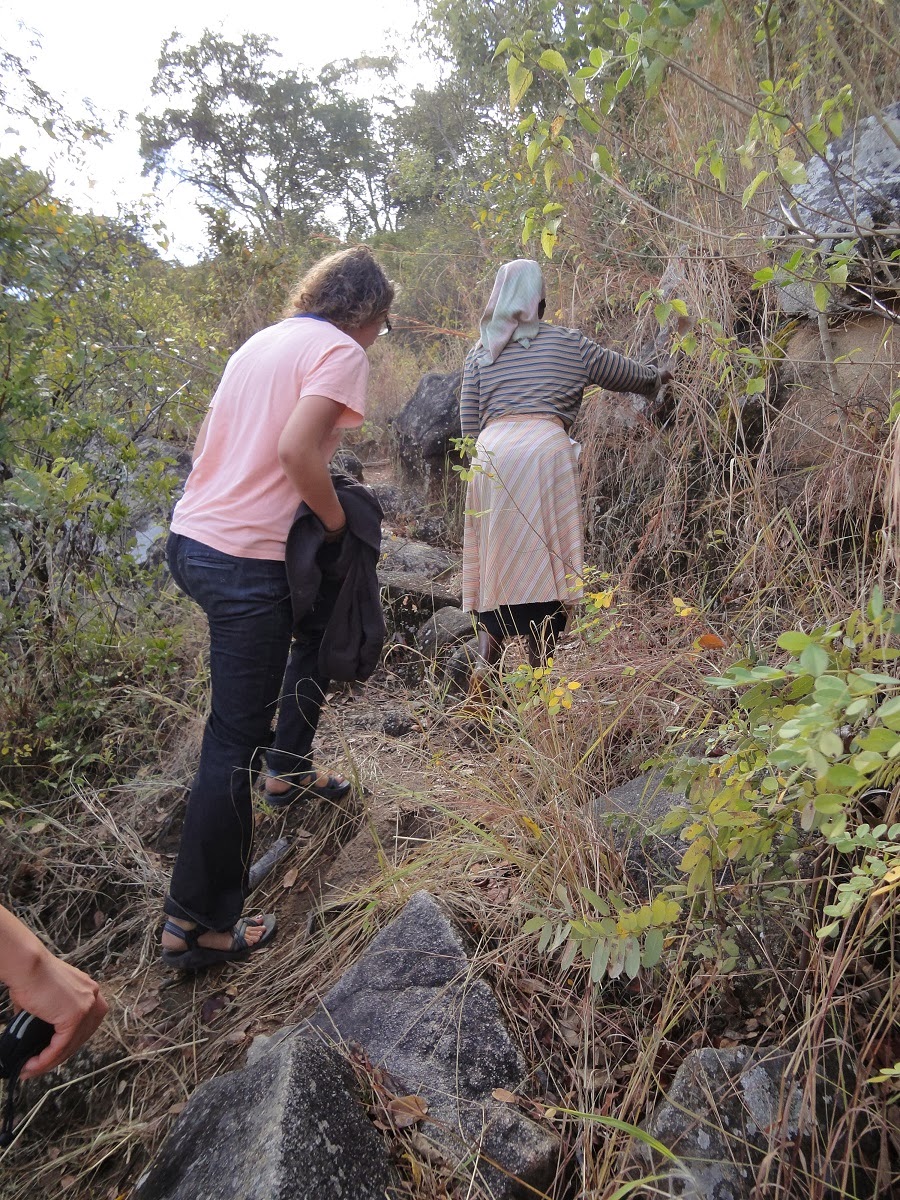 |
| Following our shoeless tree-carrying woman. |

 |
| Anna and her Director. |
 |
| Ancient History, bro. |

 |
| The View from the top. Zimbabwe's those big mountains on the Left Side. |
Chamoio Anna and I parted ways the next day. School was starting up again for her, so she needed to get back to work. Messica Anna, however was still free. So we went to Beira.
Beira is a confusing city. It makes you think that it's developing and evolving as good as of them, but it's also a marvelous liar. Beira shoes progression, but it's got some pretty horrific poverty too. One thing that stands out is the Grande Hotel. Anthony Bourdain talks about on his show "No Reservations" during the Mozambique episode. Well, we went there. Nothing he says is exaggerated. A place that was once one of the nicest 5-star hotels in the world is now hell on earth.
Thousands of people living in what must be one of the most densely populated placed anywhere. It makes me think about the Kowloon Walled City. Rooms, closets, bathrooms, balconies, stairwells, and every single corner had already been claimed. People how had claimed space in the Grande Lobby brought in their own bricks and rocks in an attempt to put up small walls in order to create even a little privacy. Capulana's served as walls for others.
The entire hotel has been stripped raw. The marble was torn of the walls, the metal bannisters in stairways have been stolen, the gates along the concrete bridges connecting the buildings is gone, and in some places it looks like people even tried to pry the rebar reinforcement out from inside the concrete walls. The structure itself is failing on a catastrophic level; Support columns are crumbling due to ignorance as a result of there having been no upkeep or maintenance since being abandoned by the company that ran it.
Today, the building has such a large population that it now has it's own localized market in the front of the complex. I bought a snack there, and while talking with some girls selling the bread cakes, I got made fun of for accidentally saying a terrible word in their local language while mispronouncing the expression "Do you live here?" Good ice breaker I guess.
They told me that the building had no electricity and no running water. Wouldn't matter even if there was anyways because all the wiring and piping has already been torn out and stolen. To get water, all the residents must take their old plastic gasoline canister across the street and pay some guy to use his tap. All three or four thousand of them.
But still, even in all it's shitty glory, and probably because they have no other options, people still call the Grande Hotel home. Scary.
 |
| Grande Hotel, Beira, Mozambique |
 |
| Grande Hotel, Beira, Mozambique |
 |
| Grande Hotel, Beira, Mozambique |
 |
| Someone drying fish on the sidewalk outside of the Grande Hotel, Beira, Mozambique. |
 |
| And then we got Chinese food for the first time in a year. |
 |
| Beria Architecture. |
 |
| Beira Church |

 |
| Some guys attaches this to his truck and makes pizza's with it around the city. |
 |
| This is Africa? |
Friday, July 26, 2013
Part 2: Malawi
We spent three days fighting with an unhappy British disc jokey, exploring the town, enjoying the beach, and watching a sunset each night that lit fire to the sky.
Here are my thoughts on Malawi in short:
- English is the National Language, but no one knows any.
- If you are white and in a tourist area, you might as well paint a target on your back.
- Chapa drivers and Cobradores in Malawi just want your money. They'll tell you they are going your way just to get you on board. If you want to know where a chapa is going, then ask one of the passengers.
- Once you get out of touristy areas, Malawi is actually pretty awesome. Easier said than done though.
- Don't stay at the french guys place in Blantyre. He sucks.
- Malawi...meh. I don't ever wanna go back.
 |
| Amsterdam, Disneyland, Tel Aviv... |

 |
| Our first glimpse of the lake. And then there were monkeys in the road and it was so cool. Then we had to stop again for monkeys. Still kinda cool. The third time though, those monkey started getting on my nerves. |
 |
| REBECCA LOOK AT THIS PICTURE |
 |
| I've got my corner on the back of this fully stocked and filled pick-up truck. And it's uncomfortable. |


 |
| Early morning swim. |
 |
| It's a touristy place, but that doesn't mean the women aren't still gonna flock to the lake in the morning to do their laundry. |
 |
| Making a dugout Canoe. |
 |
| The Hostel Manager where we stayed was a great guy, he offered to cook for us one night, and we ended up getting what was probably the best meal of the trip out of it. We asked for something standard in Malawi. Like, something his mom used to make for him when he was a kid. Something special and delicious. His eyes lite up, and this feast is what we got. |

 |
| Pretty good dinner at the psychotic French guy's place, but also, pretty psychotic frenchmen. |
Monday, July 22, 2013
Balama - The Start of the Bush Trip
We set out early, uncertain of what we’ll encounter in terms of a ride, but still excited to see what we are getting ourselves into. We start walking west, in the direction of Niassa, and then after a few kilometers, we rest. After a peanut butter and banana sandwich, we start walking again. The air is crisp and the scenery is breathtaking. Cabo Delgado’s tallest mountain appears in the distance as we pass by fields of tall grass helplessly swaying in the wind. We pass rivers, small ponds, and all sorts of colorful flora as we venture further and further into the bush. Minutes pass like seconds, and it feels like no time at all has past when we finally catch a break after about an hour and a half of walking.
Our break came in the form of two large 18-Wheelers loaded up with bags of cement and headed into Niassa along the infamous dirt road. Each truck was being driven by a Chinese man who spoke little to no Portuguese and looked like he was from an equally matu part of China. Fortunately for us, their cabins were empty and they were feeling generous, so Anna and I hopped into the second truck.
After a flat tire in the middle of nowhere and nearly 6 hours of never going over 30 kilometers per hour, we got dropped off about 30km from Marrupa. This was the end of the road for our new foreign friends. We said our goodbyes (or tried to), and then started walking again. After just a little while, we end up getting picked up by some more Chinese roads guys in a really nice range rover, but this time group was a bunch of engineers. They gladly moved some stuff around so that we could squeeze into the bench seat with them. As we drove, they gave us a tour of their newly constructed road that was in the midst of being paved. The progress they were making was outstanding. Work crews out in full force, active machinery, supplies, direction and results. It was quite the difference from what we encountered on the other side. During the ride, I learned from the driver that his company had been contracted to build and pave the road between Marrupa and the border with Cabo Delgado. The government has long wanted to build and east-west road across the two provinces in order to connect Lichinga, the largest city in Niassa, to Pemba, the largest city and closet port. The Chinese company was about a month away from completing their portion of the assignment, while the Italian Engineering firm that was hired to do the same thing on the other side between Montepuez and the border of Niassa hadn’t even started. The Cabo Delgado portion of the road was still nothing more than dirt and sand flanked by tall grass.
The engineers took us all the way to the Marrupa Airport where they lived about 7k outside of town. So again, we resorted to walking. Along the way, we talked with a Mozambican laborer who worked with the Chinese Crew. He told us about his job and how his day started at 5am and went until 5pm. For his efforts he was paid a nominal fee between 3000-4000 Meticais per month ($100-$130).
We walked a little more before catching a boleia in the back of a National Power Company Pick-Up Truck into town. That’s when we caught our first glimpse of the city. Marrupa is a gorgeous and mysterious oasis perched on top of a long hill with bairros (neighborhoods) crawling down the sides. The main street is paved and lined with street lamps. The city’s clean and the buildings aren’t falling apart at the seams. The first time you pass through, you almost forget that you’re in Mozambique.
To conclude an exhausting day of traveling, we found a pensão, explored a little bit, satiated Anna's capulana craving, found a restaurant, ate, and then went to bed in preparation for a very early morning chapa ride to Cuamba.
Here are some picture of the first leg of the Journey.
Balama:
 |
| We started walking out of town one day to try and climb a mountain and slowly, over the course of the four hours we walked our group expanded exponentially until we have an army of like 25 criancas haning off of us. |


 |
| The Sunset off of Raf's Veranda. |
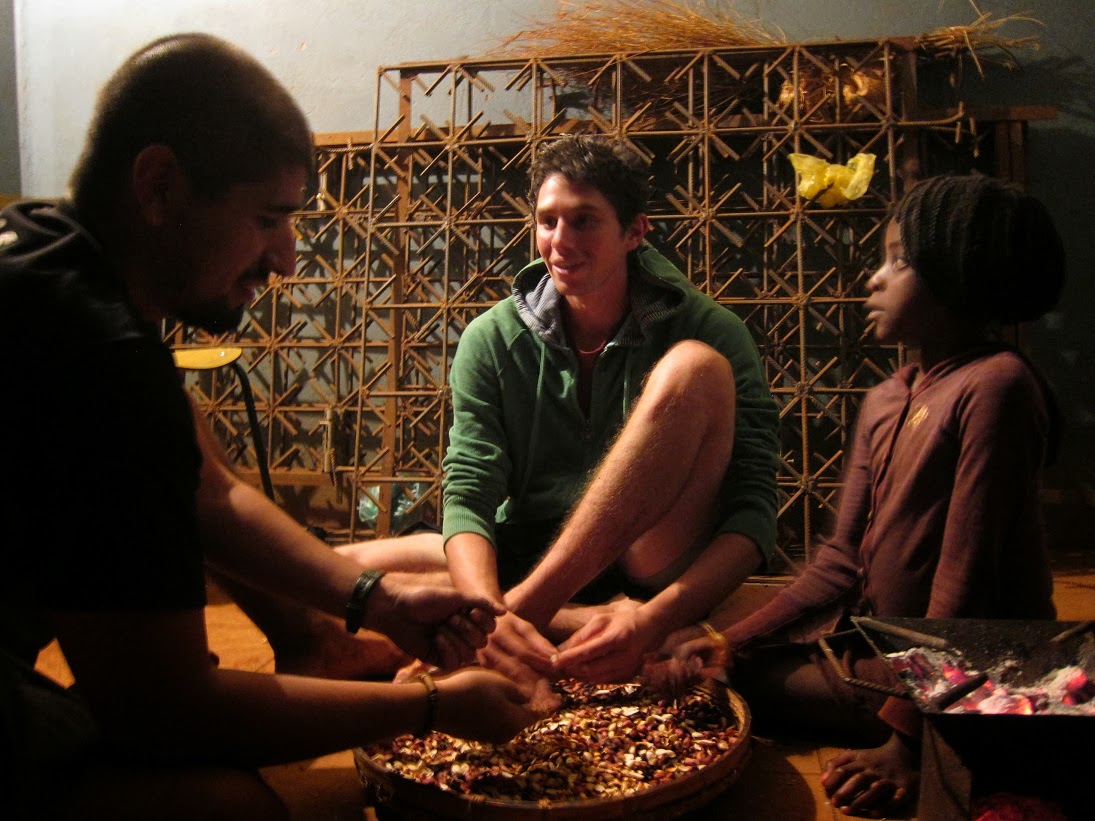 |
| Making Peanut Butter Raf's way. Roast the peanuts, peel the peanuts, smash the peanuts and add some sugar, salt and cinnamon. The whole process is easier if you make kids do it for you. It's not child labor if you make a game out of it and pay them in Peanut Butter. |
 |
| The Road from Balama towards Niassa. |
 |
| Walking out of Balama... |
 |
| Catching our Boleia in the Chinese Guy's 18-Wheeler. This is the view along the way. |


 |
| Whomp, whomp. Getting a flat Tire in the middle of no-where. |
 |
| Back at it after a quick repair. Still running through cabo. |


 |
| Leaving the District of Balama, the last district in Cabo Delgado before the boarder with Niassa. Next Year there is supposed to be a huge bridge here. Me? I'm not so optimistic about that happening... An Italian Engineering Firm was contracted to do it. And also they are supposed to pave the road up until Montepuez. But apparently, they aren't doing anything because nobody's paying them. |
 |
| Our first glimpse of Niassa and we're slapped in the face with a huge infrastructure project. The provincial government is building horizontal highway across the entire province of Niassa in an attempt to connect Lake Malawi with the Indian Ocean. The section of road between Marrupa and the border with Cabo Delgado is being built by a Chinese Engineering Firm. This road will be paved the following week and the road will be open before the rainy season comes in November. This, I'm way more optimistic about. |
 |
| New road off to the right. Can't drive on it because they put big branches on it. Some nice scenery too. |
 |
| Looking Victorian in the back of a pick-up truck on the way to Marrupa. |
 |
| Next day on the Chapa ride from Marrupa to Cuamba. We lucked out and managed to get the two seats inside the cabin of a 3am open-back chapa. 6 hours later, we were in Cuamba. We used Cuamba as a hub for the night, visiting some of our Colleagues who are stationed at a university for primary school teachers. We left Cuamba early the next morning with Malawi in mind as our destination. A private chapa took us to Mandimba, a sketchy border town and our entry port into Malawi. We actually have a colleague who lives there too, so we stopped in to see her. At her house we ran into Matt, who lives in northern Niassa. Ten minutes later, we had a third member of our party heading into Malawi. Getting the 7km from Mandimba to the Border was a trip in itself. |
 |
| Mandimba has an entire industry that's pretty unique to it's location: Bike Taxi's. Ton's of men, young and old, earn their living putting people on the backs of their bikes and taking them to the border in style, sort of. It's pretty awesome. |
 |
| Matt told the taxi driver that he wanted to drive, so this guy got paid to take his own taxi. Matt did a hell of a job, the last 4 km's are up a huge hill. |
 |
| Malawi............. |
Subscribe to:
Posts (Atom)